
Oman, located in the southeastern Arabian Peninsula, draws tourists with its diverse landscapes and rich cultural heritage. [Photo provided to China Daily]
Nestled in the southeastern Arabian Peninsula, Oman is a treasure trove of natural wonders and timeless culture. Its diverse landscapes, from rugged mountains, winding wadis and golden dunes to pristine coastlines, blend seamlessly with five UNESCO World Heritage sites and ancient souks, making it a major draw for tourists.
Tourists can visit the Sultan Qaboos Grand Mosque in the capital Muscat and breathe in the earthy scent of frankincense in a bustling souk, just like stepping into the book, The Arabian Nights.
Oman's Ministry of Heritage and Tourism recently held roadshows in Beijing, Shanghai and Guangzhou in Guangdong province to promote its natural beauty and rich heritage, and deepen cooperation with the Chinese tourism sector.
At these roadshows, over 20 tourism suppliers from Oman conducted negotiations with about 200 representatives from China's tourism industry.
Official data showed that in 2023, Oman's biggest visitor growth market was China with a 272 percent rise year-on-year. In 2024, Oman welcomed about 3.8 million international visitors, of whom around 73,000 were Chinese.
Oman offers visa-free entry for up to 14 days to Chinese tourists, while China has introduced a 30-day visa-free policy for Omani passport holders, effective from June 9, 2025, to Dec 31, 2026, covering purposes such as tourism, business, family visits, exchanges and transit.
On Nov 30, China Eastern Airlines launched the first direct air route between China and Oman operated by a Chinese carrier, with flights between Beijing and Muscat operating twice weekly.
"These are important steps to boost tourism between the two countries. I'm optimistic that the direct flights will attract more Chinese tourists to Oman," says Azzan Al Busaidi, undersecretary of tourism at the Ministry of Heritage and Tourism, who attended the roadshows in China.
"Oman's tourism offerings are authentic and diverse, catering to the growing demand in the Chinese market. They range from cultural, heritage and historical experiences to luxury and adventure travel."
According to Al Busaidi, attractions such as Oman's National Museum offer tourists a fascinating window into its rich heritage. Its long-standing history of open trade — including historical ties with China — resonates deeply with culture lovers. Visitors can also immerse themselves in the country's timeless history by wandering its ancient souks.
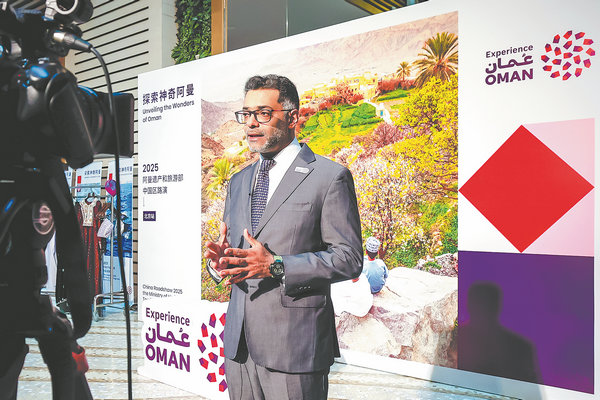 Azzan Al Busaidi, undersecretary of tourism at Oman's Ministry of Heritage and Tourism. [Photo provided to China Daily]
In the field of cultural heritage, he's convinced there is an opportunity for further exchange of expertise, knowledge, ideas and initiatives, which will not only boost cultural cooperation between Oman and China but also allow tourists from both countries to learn more about each other.
At the roadshow in Beijing, Al Busaidi announced the launch of the ministry's official accounts on Chinese social media platforms WeChat, Xiaohongshu and Sina Weibo together with its updated Chinese-language website.
"It ensures that information about Oman is accessible, engaging and tailored to the needs of Chinese travelers," he says.
"Beyond traditional marketing methods, it's crucial for the ministry to leverage Chinese social media influencers and key opinion leaders in the tourism industry. They can share their personal, authentic experiences in Oman online."
Al Busaidi highlights the country's infrastructure, such as airports, well-developed road networks, and quality hotels, alongside the hospitality of a nation long open to trade and friendship.
"It's important to equip Oman's tourism suppliers such as hotels and scenic spots with Chinese traveler-friendly amenities, including payment options, Chinese-language services and food selections. Such preparations have been underway for some time," he says.
"By global standards, Oman and Muscat have been ranked among the world's safest destinations for many years. This is very important for travelers, both from China and around the world."
Oman serves as a vital country along the ancient Maritime Silk Road and a crucial transportation hub with profound historical significance. Ming Dynasty (1368-1644) navigator Zheng He visited Oman several times during his seven epic maritime expeditions to over 30 countries and regions. His fleet brought silk and porcelain, exchanging them for local specialties such as frankincense.
"With the increased demand for tourism from China to Oman and Oman being part of the Belt and Road Initiative, we have a great opportunity to increase investments in the tourism sector," Al Busaidi says.
"Several Chinese enterprises have already made direct investments in various sectors of Oman, with a growing interest in investing in the tourism industry."
He believes that more such investments will help boost the number of visitors between the two countries.